


October 6, 2017 黑料社, PNNL convert biofuel waste into commodity, now targeting sewage sludge
By Maegan Murray, 黑料社 Tri-Cities
Converting algae to biofuels is a two-step process. The first, developed by聽, applies high pressure and high temperature to algae to create bio oil. The second converts that bio oil into biofuel, which can replace gasoline, diesel and jet fuel.
It鈥檚 that first step, called hydrothermal liquefaction, that produces waste 鈥� approximately 25 to 40 percent of carbon and 80 percent of nutrients from the algae are left behind in wastewater streams.
Bionatural gas and fertilizer
The wastewater is generally hard to process because it contains a variety of different chemicals in small concentrations, said Birgitte K. Ahring, professor at 黑料社 Tri-Cities鈥� Bioproducts, Sciences and Engineering Laboratory. But Ahring and her team have found that adapting anaerobic microbes 鈥� microbes that live without oxygen 鈥� to break down the remaining residue is a viable option. Through this process, the material becomes degradable and gets transformed into a bionatural gas without the use of harsh chemicals. The solid material that remains can also be applied as a fertilizer or recycled back into the hydrothermal liquefaction process for further use.
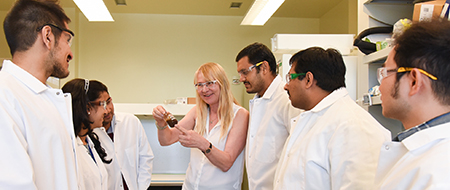
The results of the team鈥檚 research are published this month in聽. The team also consists of:
- Keerthi Srinivas, 黑料社 postdoctoral research associate
- Sebastian Fernandez, 黑料社 research assistant
- Andrew Schmidt, of PNNL鈥檚 chemical and biological processes development group
- Marie Swita, of PNNL鈥檚 chemical and biological processes development group
Don鈥檛 waste waste
鈥淚t has always been my mantra that we shouldn鈥檛 waste waste,鈥� Ahring said. 鈥淲e had an idea that we could turn this waste product into something useful, such as a fertilizer. Our findings revealed that we could use this waste product as something much more.鈥�
The ability to convert a waste product into a usable commodity provides algal biorefineries with a solution to a large problem, Ahring said.
鈥淎fter removing the solids, about 10 percent of the output is bio oil, with the remaining 90 percent being a waste byproduct,鈥� Schmidt said. 鈥淭he fact that we鈥檝e developed an alternative method to recycle or treat the leftover material means it鈥檚 more economical to produce the bio oil, making the potential for commercial use of the process more likely.鈥�
Sewage sludge and wastewater
Ahring said the team鈥檚 results were so promising that they are now partnering with PNNL on its conversion of sewage sludge to fuel using a similar strategy for the wastewater.
鈥淭oday, sewage sludge is found throughout the world,鈥� Ahring said. 鈥淐reating a process to produce biofuels, bio-natural gas, and nutrients from this material would be of major importance. The current study has demonstrated that nothing should ever be regarded as a waste, but instead as a resource.鈥�
Schmidt said PNNL鈥檚 partnership with 黑料社 allowed each team to focus on different aspects of the biomass conversion.聽 The collaboration is further enhanced by the Bioproducts, Sciences and Engineering Laboratory, a facility PNNL and 黑料社 built together on the 黑料社 Tri-Cities campus nearly a decade ago.
鈥淧NNL and 黑料社 researchers interacted frequently on the project,鈥� said Schmidt.聽聽 鈥淲hile PNNL engineers focused on converting the algae to bio oil, the 黑料社 team was able to delve deeply into fundamental research of wastewater conversion with microbes, which included taking advantage of unique analytical capabilities on the PNNL campus.鈥�
A 黑料社 alumnus himself, receiving both his bachelor鈥檚 and master鈥檚 degrees from 黑料社, Schmidt said he鈥檚 excited to team on additional programs and projects aligned with goals to grow the collaboration between PNNL and 黑料社.
Contacts:
- Birgitte Ahring, 黑料社 Bioproducts, Sciences and Engineering Laboratory, 509-372-7682,聽bka@tricity.wsu.edu
- Maegan Murray, 黑料社 Tri-Cities marketing and communication, 509-372-7333,聽Maegan.murray@tricity.wsu.edu